Linear inequalities
- If a < b, then a + c < b + c. Adding the same number to each side of an inequality does not change the direction of the inequality symbol.
- If a < b, then a – c < b – c. Subtracting the same number from each side of an inequality does not change the direction of the inequality symbol.
- If a < b and if c is a positive number, then a · c < b · c.
Multiplying each side of an inequality by a positive number does not change the direction of the inequality symbol. - If a < b and if c is a positive number, then

Dividing each side of an inequality by a positive number does not change the direction of the inequality symbol. - If a < b and if c is a negative number, then a · c > b · c.
Multiplying each side of an inequality by a negative number reverses the direction of the inequality symbol. - If a < b and if c is a negative number, then

Dividing each side of an inequality by a negative number reverses the direction of the inequality symbol.
Now, let’s apply those rules to some examples. First, simplify the linear inequality 4x – 3 ≥ 21 and solve for x. You first need to add 3 to each side, and then divide each side by 4. The inequality symbol remains in the same direction.
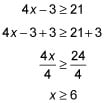
Any number 6 or greater is a solution of the inequality 4x – 3 ≥ 21.
Now let’s try an example that involves dividing by a negative number: solve 16 – 5x < 11 for x. In this case, you first need to subtract 16 from each side and then divide by –5. Dividing by a negative number means you reverse the inequality symbol.
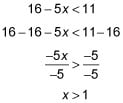
Any number greater than 1 is a solution of the inequality 16 – 5x < 11
Achha ha sir
ReplyDelete